
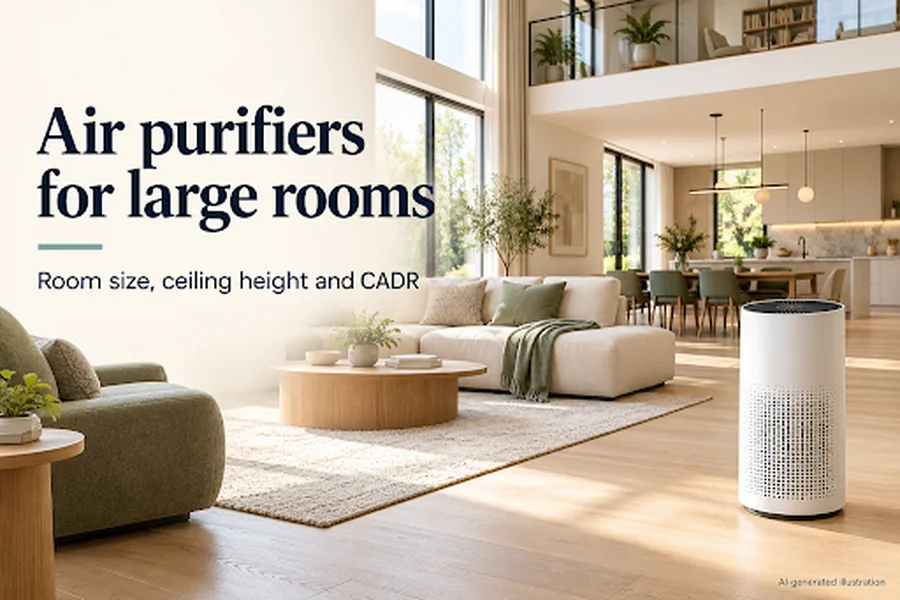
In many homes, the living room now opens onto the kitchen to form one large space. A small air purifier tucked into a corner makes little difference there. In that case, choosing the right unit starts with a tape measure. Floor area, ceiling height and CADR are enough to find the right size.
Why a large room changes the equation
An air purifier only cleans the air that passes through its filters. The bigger the room, the more filtered air it has to deliver every hour for the same effect. A living room that opens onto the kitchen or hallway behaves as a single volume: air moves freely, so the whole space counts.
Ceiling height matters too. A high ceiling, a mezzanine or an open staircase adds volume without changing the floor area.
How do you work out the CADR you need?
CADR, or clean air delivery rate, is the volume of particle-free air a unit delivers every hour. To size your air purifier, follow these steps:
1.Measure the length and width of the living area, including any space that opens onto it.
2. Multiply the two to get the floor area.
3. Aim for about 12 m³/h of CADR per square metre. This comes from the sizing chart of the US Environmental Protection Agency (EPA): about 65 cfm per 100 sq ft. The chart assumes a ceiling of about 2.4 m (8 ft).
4. If your ceiling is higher, choose a unit rated for a larger area.
5. Finally, check the room size recommended by the manufacturer and the conditions under which it was measured.
A 40 m² (430 sq ft) living room therefore needs a CADR of around 480 m³/h (about 280 cfm). A 60 m² (645 sq ft) open-plan space needs around 710 m³/h (about 420 cfm).
One large unit or two smaller ones?
In a single open room, one unit sized for the whole area and placed in the middle of the living space is often the simplest option. If the room is L-shaped, or the dining area sits far from the sofa, two smaller units spread the filtration more evenly.
Adding up the CADR of two units gives a rough figure, provided they run at the same time and air moves freely between the two areas.
Where should an air purifier go in an open-plan room?
Put it where you spend most of your time, near the sofa or the table, rather than in a dead corner. Stand it on a flat, stable surface with space around it so that air can circulate. Keep it away from curtains and furniture that would block the air inlet or outlet.
Whichever brand you choose, the user manual explains where to place the unit. Coway, for example, includes placement instructions in the manual of every purificateur d’air Coway sold in France. Run it with the windows closed, once the room has been aired. Otherwise, it mostly filters the air coming in through the window.
Which features matter in a large room?
In a living space, air quality changes through the day with cooking, cleaning and people coming and going. An air quality sensor and an auto mode adjust the fan speed without you having to think about it. A colour indicator also shows the state of the air at a glance.
The Airmega 350, for example, is positioned in France as a purificateur d’air pour grandes pièces, an air purifier for large rooms and open-plan spaces. Its manual describes three-stage filtration: a pre-filter, a HEPA filter and activated carbon. A four-colour indicator shows air quality, and auto mode adapts the fan speed to the pollution it detects.
Think about noise as well. To treat a large volume, the unit runs at high speed more often. The Airmega 350 manual notes that at maximum speed it uses more energy and may be noisier. A sleep mode, which switches off the display lights and lowers the speed, is useful if the living room doubles as a spare bedroom.
In short
Measure the whole open area, allow for ceiling height and aim for a CADR in proportion, around 12 m³/h per square metre. Then place the unit at the heart of the living area with space around it, and choose an auto mode to follow changes through the day.
FAQs
What air purifier do I need for a 40 m² living room?
Aim for a CADR of about 480 m³/h (around 280 cfm), based on the EPA sizing chart converted to metric units, for a ceiling of about 2.4 m. Include the kitchen or hallway if they open onto the living room, and check the room size recommended by the manufacturer.
Is one air purifier enough for a room that opens onto the kitchen?
Yes, if it is sized for the whole area and placed in the middle of the living space. If the room is L-shaped or the kitchen is far away, two smaller units spread the filtration better. It does not replace the cooker hood while you cook.
Where should I put an air purifier in a large living room?
Close to where you spend most of your time, on a flat surface, with space around it and nothing in front of the air inlets and outlets. Avoid dead corners, curtains and the back of a sofa, which all restrict the airflow.
Does ceiling height change the choice?
Yes. The EPA sizing chart assumes a ceiling of about 2.4 m (8 ft). With a higher ceiling, a mezzanine or an open staircase, the volume of air increases. Choose a unit rated for a larger area than the floor area you measured.
Is an air purifier for a large room noisy?
Noise depends mainly on fan speed: the higher the speed, the more audible the unit. In a large living room it runs at high speed more often, so compare noise levels at the settings you will use and check that it has a sleep mode.
Does an air purifier replace ventilation in a large room?
No. Air the room every day with the windows wide open to renew the air and remove moisture, then close them before switching the unit on. An air purifier supplements ventilation and source control. It does not replace them and is not a medical treatment.